|
San Simón Zunil, Guatemala
The photographs are thumbnails.
* * * I met Yac Nahosha on my way down a wide, buttressed dirt path to the floor of the valley. He lives in Zunil, but only occasionally now. He is a poet and has published two books in Costa Rica. We began to talk and he invited me to his house, so we turned back and walked up through the streets and pathways. His room is a large one-room, freestanding structure about 25 by 40 feet with a dirt floor, a bed and a table. It is part of a compound of three other houses where his brother, his brother's wife and two sons, his grandfather, and his parents live. I read a Spanish exercise to him that I had written about wanting to listen to the heart of the world and he smiled, complementing the sentiment. I also told him I had written some songs and had a dream to someday write one in Spanish. His brother ran to fetch a guitar. We sat in the sunny dirt courtyard while Yac sang two songs. They were emotionally charged and beautifully done. Even Yac's two rambunctious nephews sat and listened. The world stopped and turned a corner before opening up in another place. The songs were sincere, expansive and full of expression. One song was telling the devil to run from the moon and the strength of the stars. We talked about how the Old Ones of Zunil and other places don't like what is happening in the world, and in particular, their towns. The children are going to school where they are exposed to radio and television and coming home wanting Sony Walkmans and other new things. The town has very little and the people are poor. They have no electricity or water in their homes, and here are these children with all these ideas. It seems the old customs are being thrown away too easily. In part they blame White Culture for this disintegration, but some know that it is the inevitability of time. I said that I had seen some of the Old Ones make faces at me but I tried to understand. I also said that I think every generation goes through this. He mentioned that there are some who are beginning to teach those children the importance of remembering the old stories, the crafts of their people and respect for their traditions. I thought it an insightful choice on their part - they are taking care to protect their culture while those traditions are still alive. One of the reasons I had gone to Zunil was to see the Saint, San Simón. I had heard stories and wanted to see him for myself. Yac, his brother and nephew walked me down to the valley floor to where the Saint was housed. I had heard that he was not in the church because the Catholics thought the cult surrounding his popularity quite pagan. They also thought that those who took care of the Saint were robbing the poor. Yac said that every year he was moved to a new location. When we arrived at the house, Yac said he did not want to come in and was going home. I thanked him for the conversation, the songs and the poetry, and we said our adiósos. * * *
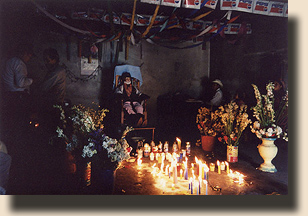
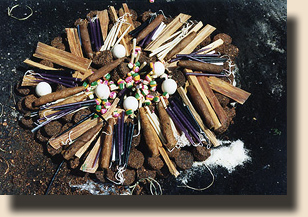
San Simón is housed in a squat, large, one-room dwelling that sits with another building and a wooden shack in a dirt yard surrounded by a four-foot stone wall. This compound is at the edge of the farms across the valley floor from the main part of town. San Simón himself is a life-sized doll who sits in a hand-carved, wooden throne-like chair against the wall away from the door of this building. He is dressed now (they change his clothes like they do the saints in the churches) in black cowboy boots, slacks, red vest, black gloves, white shirt with black tie, rainbow-tinted, reflective, aviator sunglasses and a fedora. His face is a painted wooden mask. There is another mask sitting on a side table. Directly in front of him are many votive candles and candlesticks in white, blue, purple, red, green, yellow, and black without holders. The candlesticks are stuck to the cement floor with melted wax. On either side of this glowing pond are large vases of flowers. Crudely made, low benches line the side walls and the close ceiling is hung with strings of plastic banners of Pepsi signs and tissue paper cut outs. There are no windows in this room and no interior lighting except the candles. The dusty, butterscotch afternoon sun came through the wide, low doorway, a sea of floating particles of earth and incense. I sat and watched for a half hour or so as a devotee who had come to speak with San Simón went through a ritual with a brujo, a male witch. She had purchased a basket of offerings at the shack next to the holy room. It contained purple, blue, white and green small taper candles, cigars, cigarettes, 6 eggs, limes, hard red, white and green Christmas candy, kindling, incense, salt and two bottles of Quetzalteca, a Guatemalan brand of aguardiente. They were to be blessed by the Saint during her session with him. The prayer man brushed her body with branches of some kind of tree on which he had squeezed lime juice. The woman knelt at the foot of the Saint, like a child at the lap of her father. She talked to San Simón while the prayer man chanted incantations. She stroked the doll's hands and leg, imploring something about her son that I could not understand. The brujo removed San Simón's hat and put in on her head. Then she stood and he put San Simón's arm around her. She began crying and pleading louder. He motioned for her to kneel and stand a few more times, charging the ritual with an electricity that filled the room. Other than myself, there were three or four other people present. One man paced near the doorway, reciting from an open Bible in his hand; the others sat on the benches. The prayer man and his helper put a cigarette in a holder, placed it in the mask's mouth and lit it. After a while, they took a bottle of Quetzalteca, which they had placed in San Simón's lap and, leaning the Saint far back in his chair, poured the contents of the bottle down his throat. They also gave the woman a small vial of liquor from the bottle. I was to learn that the Quetzalteca given to the doll to "drink" is later released into a large aluminum bowl beneath the throne and resold as sacred liquor. By this time the woman was enraptured and speaking more fervently. The prayer man placed his hands on her head, called to the Powers and shook her head. She spasmed and moaned in a loud, supplicating voice. This part of the ritual was concluded. They left and I sat a while longer. Finally, I went out
into the dirt yard. There were people scattered around the area, some of them apparently
paying attention to nothing and others who were watching me. I felt uncomfortable being
the Blue-Eyed One and holding a camera. A woman walked up and asked if I had paid to get
in. At first I didn't understand her Spanish, and
when I did answered, no, how much is it? A Quetzal, she said. I paid her and drifted over to where
the woman from the room had gone. I stood there for a while and eventually the she looked
up and offered a seat next to her. I sat down on an upturned log and watched.
When he had finished his preparation and was continuing to chant, the woman leaned toward me and asked if I wanted to take a photo. I was stunned by her casual behavior, saying that I didn't want to bother them. She said, "No, no, no, it's okay," and brushed the brujo aside, telling him to stop for a moment. I felt self-conscious but jumped at the chance and took two. I thanked her and she asked if I wanted to take more. I said no, so she told the prayer man to continue. As he was praying she asked if I had taken a picture of San Simón. I couldn't believe my ears. It was strange enough being there alone, but I never expected this. Obviously, she wasn't from Zunil- she wore Western clothing and short hair and spoke English - and she seemed perfectly comfortable telling the priest to stop. I told her I didn't know it was possible. She said, "Sure! It costs Q5." I thought this humorous in such a serious environment. She then told an adolescent who was with her to take me to the men in the holy room. I got up and followed him. The young man approached two men and told them I wanted take a picture of the Saint. The two spoke between themselves and, turning to me, simply said, "Q5 for one photo." I explained that I only had a Q20 note and did not have change. One of the men said, "no problem," and lifted a handkerchief covering a large wooden bowl on the table in the corner. It was brimming with money. He quickly made change and told the men who were standing near to move out of the way. I walked around the room looking for an angle for the shot. The man who had taken my money switched on a weak, dirty, bare light bulb hanging up above the dusty Pepsi banners and asked if that was better. I told him I had a flash on my camera and the added illumination was unnecessary. He turned off that poor excuse for lighting. I took a picture and the flash did not go off. I checked the camera and everything seemed to be in working order. I wondered if the two men would want me to pay again to take another one. They argued back and forth while I insisted that the photo was no good. After a full minute or so they agreed to let me take another for free. I double-checked my camera, squatted down in the position I wanted and took another frame. Again, the flash did not engage. I became very tense, frustrated and confused. As I stood looking at the damned camera a crusty old woman sitting on one of the side benches a few feet away glared at me. I said I didn't understand why my camera had this problem. She bent forward and, wildly shaking her finger at me, spit out, "San Simón doesn't want you to take a picture of him! That's why you have a problem with the camera!" I was shocked at her outburst and reeled away towards the door. The others in the room just stared at me as I drifted back outside. By this time the prayer man had finished chanting and building the pyre. He ignited the kindling and used it to light the charcoal. In a few minuets the cakes of incense took fire and a furious column of smoke rose from the ground, dancing in the afternoon breeze. He stood facing the offering, chanting in K'iche', which is the language he had used all along except when speaking to the woman. Suddenly, he jumped through the rising smoke, disappearing on the other side of the circle. He continued chanting and walked a quarter of the way around the circle's perimeter, stopped for a few seconds and leapt through the smoke again. He crossed back and forth, chanting and changing directions several times. Finally, taking a long stick, he stirred the flaming mixture, causing a huge billow of smoke to surge throughout the compound and into the sky. I stayed a few more minutes, thanked the woman for her time and left. Before doing so, though, I watched someone clean up the ashes of an earlier burnt offering. The ground was perfectly cleared - it was as if nothing had ever happened. * * * After returning to Quetzaltenango, I went to my room to shower and put on warmer clothes for the evening. I also wondered if the camera battery was failing and began checking. Holding it pointed towards me at arm's length, I pushed the shutter button half way down to make certain the infra red beam which operates the flash was functioning. The flash went off in my face.
|
|
|

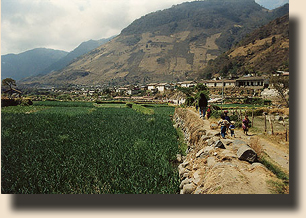
 Zunil is a small pueblo
stacked against steep hills. The valley below it, like the hillsides above it, is green
with a patchwork of gardens and farms between borders of field rock. The pueblo
itself is a maze of steep, dusty cobblestone streets and wide dirt paths that serve as
side streets. Views of the surrounding countryside are everywhere. The houses, shacks and tiendas
are one short story tall and many of the doorways are between 5 and 5-1/2 feet tall. There
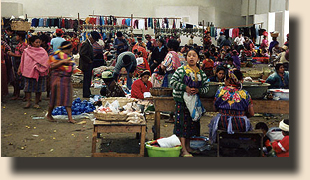
are only two buildings that are different- the Church and the mercado. This latter
building has a four-storied, arched, corrugated aluminum roof and has no interior walls.
It looks like a cinder block airplane hangar and is nondescript in its ugly plainness. The
people are pure K'iche' and poorer than their neighbors in Almolonga, the vegetable market
for much of Central America. Many of those in Zunil wear no shoes and run up and down the
haphazard streets with bundles on their heads or backs.
Zunil is a small pueblo
stacked against steep hills. The valley below it, like the hillsides above it, is green
with a patchwork of gardens and farms between borders of field rock. The pueblo
itself is a maze of steep, dusty cobblestone streets and wide dirt paths that serve as
side streets. Views of the surrounding countryside are everywhere. The houses, shacks and tiendas
are one short story tall and many of the doorways are between 5 and 5-1/2 feet tall. There
are only two buildings that are different- the Church and the mercado. This latter
building has a four-storied, arched, corrugated aluminum roof and has no interior walls.
It looks like a cinder block airplane hangar and is nondescript in its ugly plainness. The
people are pure K'iche' and poorer than their neighbors in Almolonga, the vegetable market
for much of Central America. Many of those in Zunil wear no shoes and run up and down the
haphazard streets with bundles on their heads or backs.